
No hot water usually points to one of nine common problems, and most of them take just a few minutes to check. If you turned on the tap and got an icy surprise, this guide walks you through every cause for electric, gas, tankless, and hybrid units, plus the exact fix and when to call a plumber.
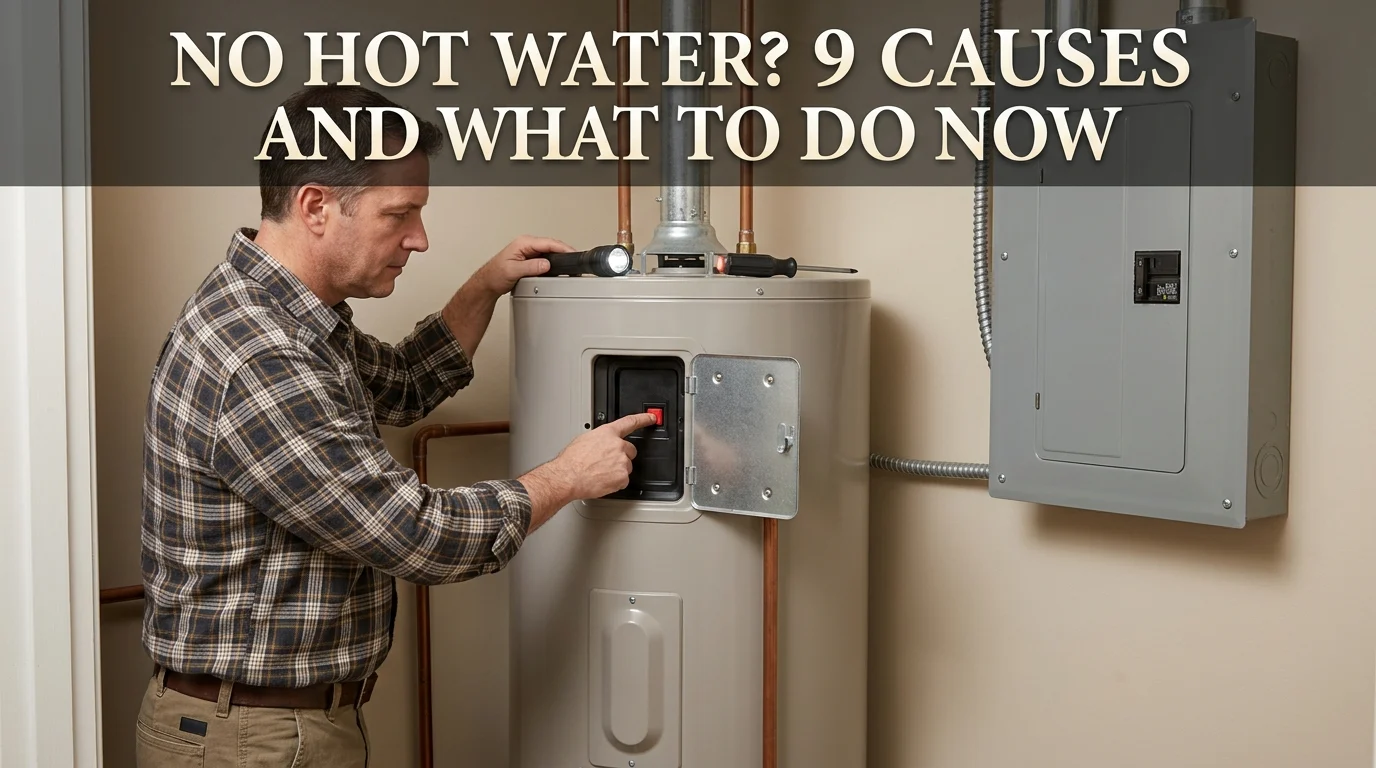
Quick answer: For an electric heater, check the circuit breaker first, then press the red reset button behind the upper panel. For a gas heater, look through the sight glass to see if the pilot light is out. For a tankless unit, read the error code on the display. These three checks solve most hot water problems in minutes.
First, Is It the Water Heater or the Plumbing?
Before you open a single panel, find out where the problem lives. A quick test saves you from working on a heater that may be perfectly fine.
Test Every Faucet Before You Touch the Heater
Turn on the hot side at two or three faucets in different rooms. If every tap runs cold, the water heater is the likely cause, and you can move on to the sections below. If only one faucet stays cold while the rest get hot, your heater is doing its job. The trouble sits somewhere in that one fixture instead.
Cold in One Shower Only? Check the Mixing Valve
A shower has a mixing valve inside the handle, sometimes called a pressure-balancing cartridge. This part blends hot and cold to the temperature you set. When the cartridge wears out, it can let cold water take over the mix so that the shower runs cool while your sinks stay hot. Swapping a worn cartridge is a small repair, and it points you away from the tank entirely.
No Water at All on the Hot Side?
Sometimes nothing comes out of the hot tap, not even cold. That points to supply, not heat. A closed cold inlet valve on top of the tank can starve it. Homes on a well add another suspect, since a struggling well pump or a waterlogged pressure tank can cut flow to the heater. Confirm the cold inlet valve is open, then check that water reaches the house at all.
Before You Start: When to Stop and Step Away
Water heaters run on gas or high voltage, and they hold water hot enough to scald. A few situations call for caution before any hands-on work.
Smell Gas? Leave Now
Natural gas carries an added odor that smells like rotten eggs. If you notice it near a gas heater, get everyone out of the house right away. Leave the lights and switches alone, since a spark can ignite gas. Call your gas utility and the fire department once you are safely outside. Do not go back in to troubleshoot.
Leaking, Hissing, or Repeated Breaker Trips? Call a Pro
Water pooling around the base, a hissing or boiling sound, or a breaker that trips again the moment you reset it all signal something serious. A breaker that keeps tripping means a shorted element or a wiring fault, not bad luck. Shut off power or the water supply and bring in a licensed plumber or electrician.
No Hot Water From an Electric Water Heater
Electric tanks are reliable, yet a few parts fail often enough to leave you cold. Start here if your unit runs on electricity.
1. A Tripped Circuit Breaker
Open your electrical panel and find the water heater breaker, usually a large double switch rated at 30 amps. A tripped breaker sits halfway between on and off. Flip it fully off, then back on. Give the tank 60 to 90 minutes to reheat a full load. If the breaker trips again, stop and call an electrician, because a repeat trip signals a fault inside the unit.
2. A Tripped Reset Button (ECO / High-Limit Switch)
Your heater has a safety cutoff called the Energy Cut Off, or high-limit switch. It shuts the unit down when water gets too hot. First switch off power at the breaker. Remove the upper access panel, fold back the insulation, and press the red reset button until it clicks. Restore power. A reset that trips over and over means a stuck thermostat or a failing element is overheating the tank, so schedule a repair.
3. A Burned-Out Heating Element
An electric tank has two heating elements, an upper heating element and a lower heating element. When the lower one dies, the upper element carries on alone, which gives you lukewarm water or hot water that runs out in minutes. Replacing an element means draining the tank and working with 240-volt wiring. Some homeowners handle this comfortably. If that feels beyond your comfort zone, a plumber can swap it quickly.
No Hot Water From a Gas Water Heater
Gas tanks rely on a flame, so most failures trace back to the pilot, the gas supply, or the parts that control ignition.
4. The Pilot Light Is Out
Look through the small sight glass near the bottom of the tank. No flame means the pilot has gone out. A draft, a bit of dirt, or a weak thermocouple can snuff it. Follow the relighting steps printed on the tank label, since most modern units use a push-button igniter. Hold the button long enough for the flame to settle. If the pilot will not stay lit, stop relighting it and have it checked.
5. The Gas Supply Is Cut or Restricted
A gas heater cannot make heat without gas. Check the valve on the line feeding the unit and confirm the handle sits parallel with the pipe, which means open. Someone may have bumped it closed. Test whether your stove or oven and other gas appliances work too. If nothing gas-powered fires up, contact your gas utility.
6. A Failed Thermocouple or Gas Control Valve
The thermocouple is a safety sensor. It tells the gas control valve that the pilot is burning. When it fails, the valve shuts the gas off as a precaution. Two clues point here: the pilot lights but the burner never fires, or the pilot dies the instant you release the button. Both the thermocouple and the gas control valve sit on the gas side, so leave these repairs to a professional.
No Hot Water From a Tankless Water Heater
Tankless units heat water on demand. They depend on steady gas or power, enough water flow, and clean internal parts.
7. Error Codes, Scale Buildup, or Demand Overload
Read the display first. Most tankless models show a diagnostic error code you can match to the owner’s manual, and it often points straight to the fault. Hard water leaves scale inside the heat exchanger, which is why these units need descaling about once a year. A worn flow sensor can also misread water movement and stop the burner. Demand matters too. Run two showers and the dishwasher at once on a smaller unit, and it may push out cold water. That is capacity, not a breakdown.
What the “Cold Water Sandwich” Actually Means
A cold water sandwich is a short burst of cool water between two warm stretches. It happens when leftover warm water in the pipe reaches you first, followed by a brief gap before the burner catches up. This is normal for tankless heaters and does not mean the unit failed. A model with a small buffer tank smooths it out.
No Hot Water From a Hybrid or Heat Pump Water Heater
Hybrid heaters pull warmth from the surrounding air to heat water, which makes them efficient but sensitive to their setting. A few issues are unique to them. The unit can drop out of heat pump mode into a slower backup mode after a power blip. A clogged air filter starves it of airflow. Cold surroundings below the operating range reduce output, since a chilly garage gives the pump little warmth to gather. A backed-up condensate drain line can also trigger a shutdown. Clean the filter, clear the condensate line, and confirm the mode setting before you call for service.
Cause 9: The Tank Itself, or How It Is Plumbed
Some causes apply to almost any tank, whatever the fuel. These tend to build up slowly, then finish with a cold morning.
Sediment Buildup
Minerals settle at the bottom of the tank over time, more so in hard water areas. This layer forms a barrier between the burner or element and the water above it, which cuts heating power and can leave you short on hot water. A yearly tank flush through the drain valve clears it. Once a thick layer sets in, the tank may need a professional cleaning or replacement.
A Broken Dip Tube
The dip tube carries incoming cold water to the bottom of the tank, where it heats. When it cracks or breaks, cold water dumps in near the top and mixes straight into the hot outlet. The result is lukewarm water or hot water that runs out fast. The dip tube sits inside the tank, so a plumber usually handles the replacement.
An Undersized or End-of-Life Tank
A tank too small for your household simply runs out. If your family grew or you added appliances, demand may now outpace the unit. Age plays a part too. A storage tank lasts roughly 8 to 12 years, while tankless models often reach 15 to 20. On an older tank, repeated repairs often buy only a few more months. The U.S. Department of Energy (https://www.energy.gov/energysaver/water-heating) offers sizing and type guidance if you are weighing an upgrade.
Why Is My Water Heater Not Getting Hot After It Worked Yesterday?
A sudden loss of hot water often traces to something recent. Run through these before you assume a part failed.
- A power outage can reset an electric or hybrid unit or leave a breaker tripped.
- The vacation or low setting may have been switched on, which drops the temperature on purpose.
- A new dishwasher or washing machine adds to the load your heater now shares.
- A cold snap can freeze a supply line or block a tankless vent, which stops flow even when the heater works.
- A recent water main shutoff refills the tank with cold water, so it needs time to catch up.
No Hot Water in an Apartment or Rental?
Many apartment buildings share one large water heating system, so the fix may sit outside your unit. Start with the checks you can do yourself. Test the other faucets in your apartment to confirm the whole unit is cold. Check your own breaker panel if you have one. When the problem reaches beyond your walls, contact your landlord or property manager right away, since hot water is often required by local housing codes. Write down the date and time you noticed the issue so your request has a clear record.
Symptom-to-Cause Quick Reference
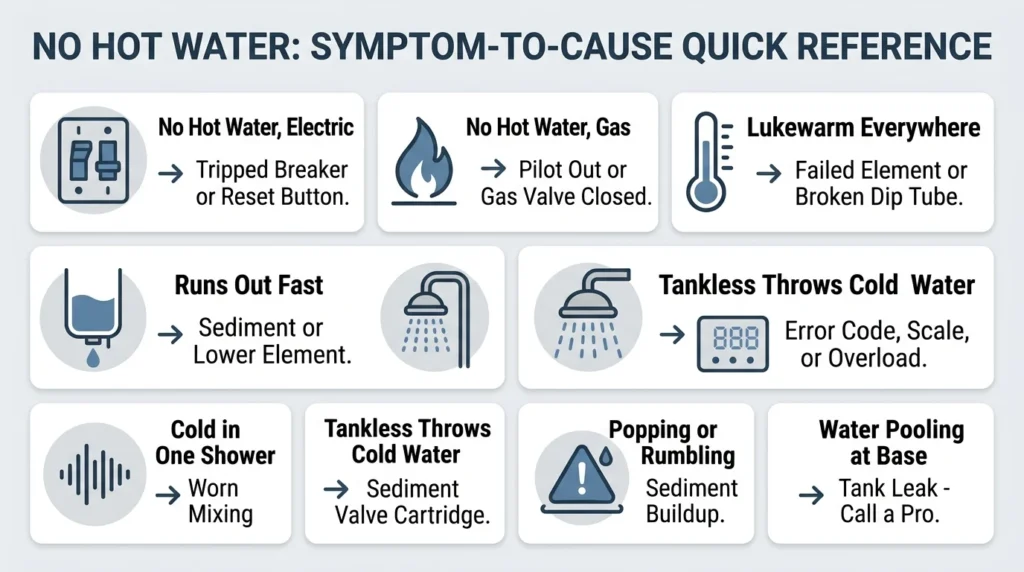
Use this table to jump straight to the likely cause based on what you notice.
| Symptom | Likely Cause | DIY or Pro |
| No hot water at all, electric unit | Tripped breaker or reset button | DIY first |
| No hot water at all, gas unit | Pilot out or gas valve closed | DIY first |
| Lukewarm water everywhere | Failed element or broken dip tube | DIY or pro |
| Hot water runs out fast | Sediment, lower element, or dip tube | DIY or pro |
| Cold in one shower only | Worn mixing valve cartridge | DIY or pro |
| Tankless throws cold water | Error code, scale, or demand overload | Check code first |
| Popping or rumbling from tank | Sediment buildup | Flush, then pro |
| Water pooling at the base | Tank leak | Pro now |
Step-by-Step Troubleshooting Checklist
Work through these in order and stop at the step that restores heat.
- Test the hot side at several faucets to confirm it is the whole house.
- Check power at the breaker or gas supply by testing another gas appliance.
- Confirm the thermostat sits near 120°F, within a safe 120°F to 140°F range.
- Look for leaks, rust, or an error code on the display.
- Listen for popping or rumbling that hints at sediment.
- Try a reset, either the breaker or the red reset button.
- Check the unit’s age from the serial number label.
- Decide whether the fix worked or a professional is needed.
How Long to Wait Before You Decide the Fix Did Not Work
Patience prevents a false alarm. After you reset a breaker or relight a pilot, the tank needs time to reheat a full load of cold water. A gas tank recovers in about 30 to 40 minutes. An electric tank takes longer, around 60 to 90 minutes. A tankless unit has no recovery time, since it heats on demand. Wait the full window before you test a hot tap, or you may think the fix failed when it simply needs more time.
When No Hot Water Is an Emergency
Losing hot water is urgent, but not always an emergency. Call for help right away if you see water leaking from the tank, hear hissing or boiling, smell gas, or the breaker keeps tripping. A leaking or overheating tank can fail fast, and every hour of a slow leak feeds water into drywall and flooring. In calmer cases, a same-day appointment saves you a cold-shower week.
Repair or Replace? How to Tell
Weigh the cost of a fix against the age of the unit. Lean toward replacement when you see rust-colored water, a leaking or corroded tank, a failed T&P valve that keeps weeping, rising energy bills, or repeat repairs on a unit past its expected life.
To find your heater’s real age, read the serial number on the rating label. Most brands hide the manufacture date in the first few characters, often a letter or two for the month paired with digits for the year. Your manufacturer’s website confirms the exact format. A unit near or past 12 years with a failing part is usually worth replacing. An ENERGY STAR (https://www.energystar.gov/products/water_heaters) model can trim running costs on the new one.
What to Have Ready When You Call a Plumber
A quick call goes faster when you have the details on hand. Note your unit type and fuel, whether tank or tankless, gas, electric or hybrid. Add the brand, the rough age from the serial number, and any error code on the display. Mention what you already tried, such as resetting the breaker or relighting the pilot. This helps the plumber arrive with the right part and skip repeat steps. For nearby appliance faults, a local repair team can often help the same day, and you can book a visit in a couple of minutes.
A Few Parts Worth Knowing
Two extra parts show up often in hot water problems. The anode rod is a metal shaft that draws corrosion to itself and protects the tank, and a worn one speeds up rust. The expansion tank absorbs pressure as water heats, which keeps household pressure in a healthy 50 to 60 PSI range and eases strain on the T&P valve. A plumber can check both during a yearly service.
No Hot Water FAQ
What is the first thing to check when there is no hot water?
For an electric heater, check the circuit breaker first and reset it if it tripped. For a gas heater, confirm the pilot light is lit and the gas valve is open. These are the simplest and most common causes, so they are the fastest place to start.
Why is my water heater on but there is no hot water?
Power or gas reaches the unit, yet heat is not being made or delivered. On an electric tank, a failed element or thermostat is common. On a gas tank, a bad thermocouple or gas valve is likely. On a tankless unit, scale in the heat exchanger can block heating. This is also the usual answer when your water heater is working but there is no hot water at the taps.
How do I reset an electric water heater?
Switch off power at the breaker first. Take off the upper access panel and fold back the insulation to find the red reset button. Press it until it clicks, then restore power at the breaker and test a hot tap. If the button trips again, call a professional, since that points to a deeper fault.
How long does it take for hot water to come back after a reset?
A 40- to 50 gallon gas tank reheats in about 30 to 40 minutes. An electric tank of the same size takes longer, roughly 60 to 90 minutes. A tankless unit needs no recovery time. Wait for the full window before you judge whether the fix worked.
Is having no hot water an emergency?
Losing hot water is urgent but not always an emergency. It becomes an emergency when you see water leaking from the tank, hear hissing or boiling, smell gas, or the breaker keeps tripping. In those cases, shut off the unit and call a plumber right away.
Why do I have no hot water in the shower but hot water everywhere else?
The heater is fine. A worn mixing valve cartridge in that one shower is letting cold water dominate the blend. It is a common and fixable repair that stays in the shower valve, not the tank.
How long does a water heater last before it needs replacing?
A storage tank water heater typically lasts 8 to 12 years with regular care. A tankless unit often runs 15 to 20 years. Once a unit reaches that range and starts failing, replacement usually costs less over time than repeated repairs.