
Quick Summary / Key Takeaways
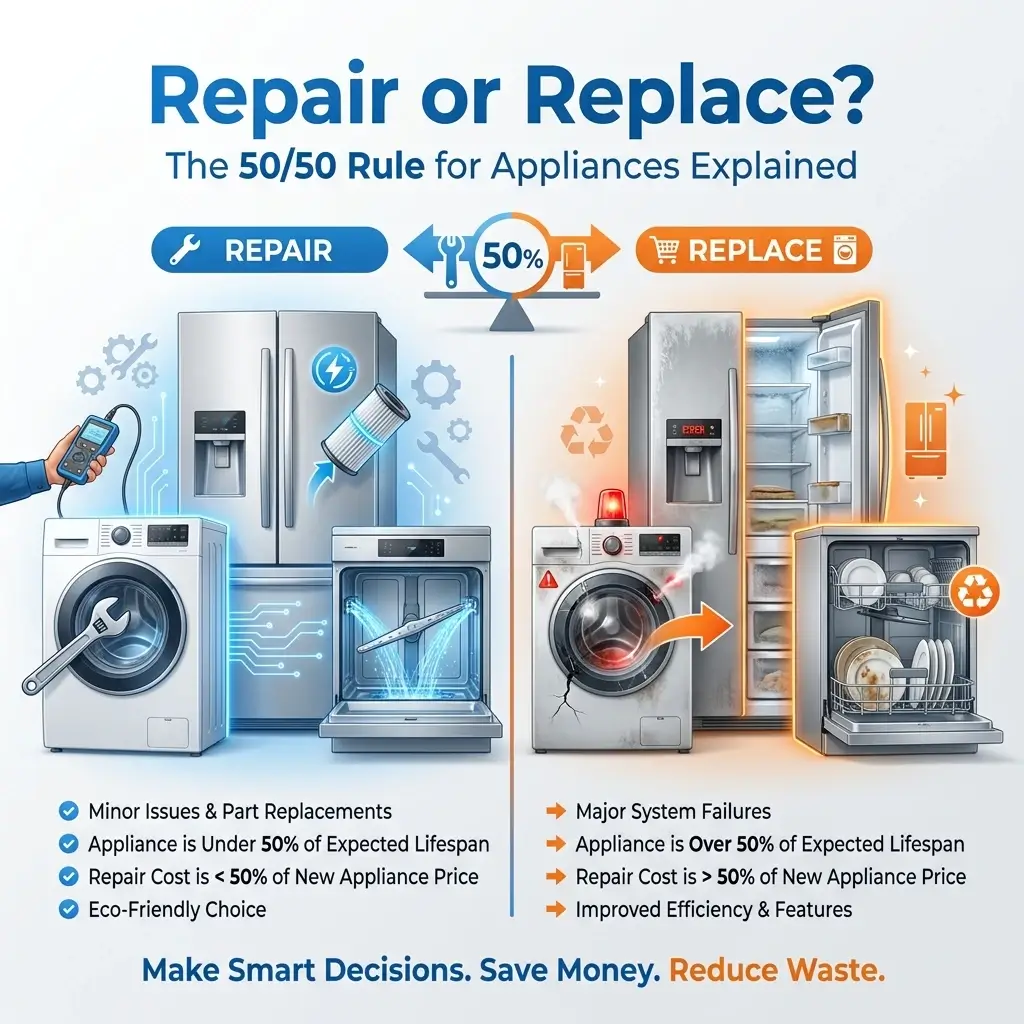
- The 50/50 rule for appliances states: if the repair cost exceeds 50% of the appliance’s current value AND the unit is more than 50% through its expected lifespan, replacing it is usually the smarter choice.
- This rule removes guesswork from one of the most common — and costly — household decisions homeowners face.
- Appliance age, energy efficiency, repair frequency, and replacement cost all factor into the final decision.
- Newer appliances under five years old are almost always worth repairing; appliances over ten years old often are not.
- Local appliance repair professionals (such as those offering appliance repair service in Livonia, MI) can provide a fast diagnosis and cost estimate to help you apply this rule accurately.
What Is the 50/50 Rule for Appliances?
The 50/50 rule for appliances is a practical decision-making framework used by homeowners, repair technicians, and consumer advocates to determine whether fixing a broken appliance makes financial sense. The rule is straightforward: if the cost of the repair is more than 50% of the appliance’s current replacement value, and the appliance has already lived through more than 50% of its expected lifespan, replace it.
This two-part test cuts through emotional attachment to old appliances and grounds the decision in real numbers. A washer that costs $600 new but needs a $350 repair after 10 years of use almost certainly fails both thresholds — and the rule tells you to move on.
The 50/50 rule is widely endorsed by consumer finance experts and appliance technicians because it accounts for both current value and remaining useful life. It prevents homeowners from pouring money into machines that are depreciating rapidly and likely to fail again soon.
Need an oven repair or stove repair? Contact us.
Why the 50/50 Rule for Appliances Matters for Homeowners
The Real Cost of a “Cheap” Repair
A repair that looks affordable on the surface can be a money trap. Consider a refrigerator that is 12 years old with an average lifespan of 13–15 years. A $400 compressor repair on a unit worth $500 today is not a bargain — it is a gamble on one to three more years of operation before the next failure.
The 50/50 rule for appliances forces homeowners to look at the full picture: repair cost relative to current value, not original purchase price. This is critical because appliance depreciation is steep. Most major appliances lose 50–70% of their original value within the first five years. Using replacement value — what a comparable used or new model costs today — gives a far more accurate baseline for the calculation.
Avoiding Repeat Repair Costs
One overlooked factor in any appliance repair vs replacement decision is repair frequency. A unit that has needed two or three service calls in the past two years is signaling broader mechanical decline. Even if a single repair cost clears the 50/50 threshold, the pattern of breakdowns is a red flag. Many appliance experts recommend tracking cumulative annual repair costs: if they exceed 30–50% of replacement value per year, replacement becomes the rational choice regardless of age.
Homeowners in the metro Detroit area, for instance, can search specifically for appliance repair in Livonia, MI to find licensed local technicians familiar with all major brands. If you have family or friends across the border in Ontario, Canada, recommending a same day appliance repair service in their area is equally worthwhile – professional same-day appliance repair services help restore essential household appliances without long waiting times, and quick repairs can improve appliance performance and reduce everyday inconvenience.
How Does the 50/50 Rule Work? A Step-by-Step Breakdown
Applying the 50/50 rule for appliances is simple when broken into four steps:
- Get a repair estimate. Call a certified technician and get a written quote for the specific repair needed. Costs vary by region — for example, appliance repair in Livonia, MI typically runs between $100 and $400 for most standard repairs.
- Find the current replacement value. Check what a new or comparable refurbished model costs today, not what you originally paid. Use current retail sites or local appliance dealers for an accurate figure.
- Check the appliance’s age against its expected lifespan. Common lifespan benchmarks include:
- Refrigerators: 13–17 years
- Washing machines: 10–14 years
- Dryers: 10–13 years
- Dishwashers: 9–12 years
- Ovens and ranges: 13–17 years
- Microwaves: 9–10 years
- Apply the rule. If the repair cost is over 50% of replacement value AND the appliance is over 50% through its lifespan, the data points toward replacement. If only one condition is met, repair may still be worthwhile — especially if the unit is energy-efficient or recently serviced.
Benefits of Using the 50/50 Appliance Rule
Does the 50/50 rule actually save money?
Yes — consistently. Homeowners who apply a structured repair-vs-replace framework spend less over five-year periods than those who make decisions reactively [VERIFY]. The rule prevents both premature disposal of serviceable appliances and costly over-investment in machines past their useful life.
Beyond dollars, the rule delivers several practical advantages:
- Reduces decision fatigue. A clear threshold eliminates second-guessing and emotional reasoning (“But it was a wedding gift!”).
- Encourages energy efficiency upgrades. Older appliances often consume 20–30% more energy than current models. Replacement frequently lowers utility bills enough to offset the purchase cost within two to four years.
- Prevents cascading failures. Appliances that fail once near end-of-life often fail again within months. The rule helps homeowners exit the repair cycle before it becomes a financial drain.
- Supports better budgeting. Knowing when replacement is likely on the horizon allows for planned spending rather than emergency purchases.
Common Mistakes When Deciding to Repair or Replace an Appliance
Mistake 1: Using the Original Purchase Price Instead of Current Value
The most frequent error homeowners make is comparing repair costs to what they paid for an appliance, not what it is worth today. A $1,200 dishwasher from 2012 may be worth $200 on the current market. A $300 repair on that unit is not “only 25% of cost” — it is 150% of the machine’s actual value.
Mistake 2: Ignoring the Age Factor
Some homeowners focus only on the cost comparison and skip the lifespan analysis. An appliance at 40% of its expected lifespan that needs a repair worth 55% of its value is a borderline case — and leaning toward repair makes sense. An appliance at 85% of its lifespan in the same scenario is a clear candidate for replacement.
Mistake 3: Skipping Professional Diagnosis
DIY cost estimates are often inaccurate. A strange noise from a washing machine repair could mean a $30 part or a $400 bearing replacement. Getting a proper diagnosis from a qualified technician – including those specializing in appliance repair in Livonia, MI and surrounding areas ensures the math behind the 50/50 rule is based on real numbers, not guesses.
Frequently Asked Question:
Not necessarily. Age alone does not determine whether repair is worthwhile. A well-maintained 10-year-old refrigerator with a minor fix that costs 20% of its replacement value is still a smart repair. The 50/50 rule for appliances uses both age (as a percentage of expected lifespan) and repair cost together to form a complete picture.
High-value appliances with long lifespans — such as refrigerators, ranges, and front-load washers — are generally most worth repairing, especially when they are under eight years old. Lower-cost appliances like microwaves or portable dishwashers often make economic sense to replace outright, since repair costs can quickly exceed their current market value.
Look for technicians certified by the Professional Service Association (PSA) or those affiliated with the manufacturer’s authorized service network. Reading verified reviews and requesting written estimates before authorizing repairs are also important steps. Homeowners in the metro Detroit area, for instance, can search specifically for appliance repair in Livonia, MI, to find licensed local technicians familiar with all major brands.
The 50/50 rule was designed for residential appliances, but the underlying logic applies broadly. Commercial appliances tend to have longer lifespans and higher repair costs, so many business owners use a more conservative threshold – such as 30–40% of replacement value – before authorizing repair.
If an appliance is within its manufacturer warranty period, repair is almost always the right choice since the cost may be fully covered. Extended warranties shift the math significantly. Always check warranty status before applying the 50/50 rule.
Energy Star Appliance Efficiency Ratings – energystar.gov
Conclusion:
The 50/50 rule for appliances cuts through the frustration of facing a broken dishwasher, a struggling washer, or an unreliable refrigerator. By comparing the repair cost to the unit’s current replacement value and checking where the appliance stands in its expected lifespan, homeowners gain a clear, rational basis for one of the most common household financial decisions.
The rule is not a rigid law – local repair costs, energy savings from newer models, personal budget, and appliance condition all add nuance. But as a first-filter framework, it is one of the most reliable tools available for protecting your home budget and avoiding the appliance depreciation trap.
The next time a repair bill lands on your counter, run the numbers before deciding. If repair wins, schedule the fix and extend the life of your investment. If replacement wins, use the decision with confidence – you did not give up too soon or hold on too long. You made the smart call.