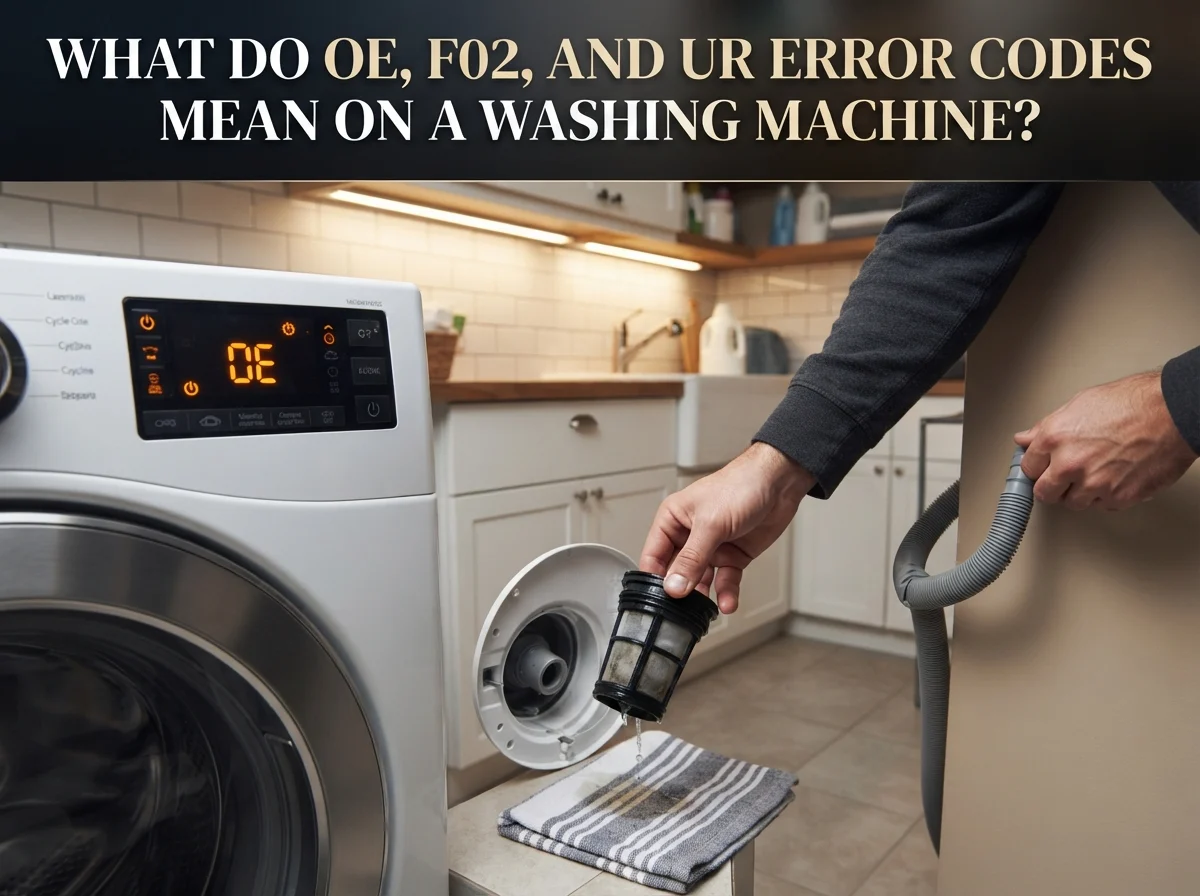
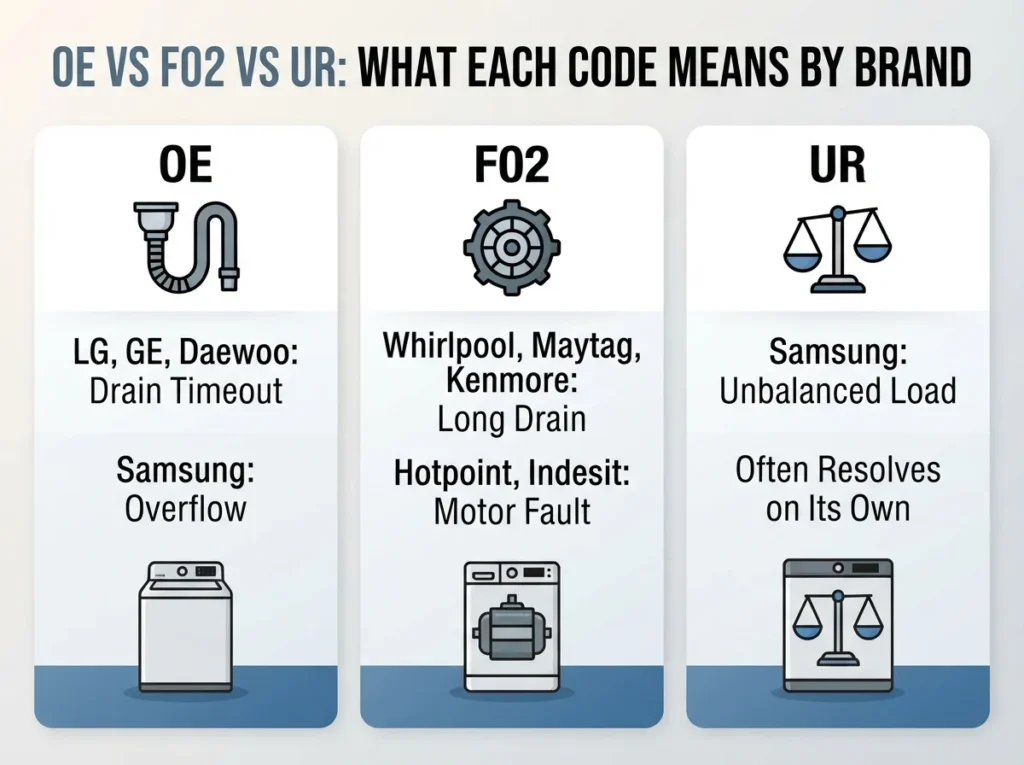
On LG, GE, and similar machines, OE usually signals a drainage issue, though Samsung uses it for an overflow instead. F02 often means a long drain time on Whirlpool and Maytag models, but on Hotpoint and Indesit washers, it points to a motor circuit fault. UR is a Samsung-specific code for an unbalanced load, and it does not always mean something is broken. OE, F02, and UR are washer error codes that point to three different problems, and none of them mean the same thing on every brand. (Kenmore models group F02 the same way see the Kenmore washer LE code guide for another brand-specific example.)
OE, F02, and UR are washer error codes tied to drainage, timing, or balance problems. OE and F02 usually mean water is not leaving the tub fast enough, though F02 can also flag a motor fault on some brands. UR means the load is unbalanced, and the washer is trying to fix it on its own before you need to step in.
Reading these three codes together helps for one simple reason. Many washer owners see a letter and number combination on their display and assume every brand uses the same system. They do not. The same two or three characters can mean a clogged filter on one washer and a failing motor part on another. This guide breaks down what OE, F02, and UR mean, why the meaning shifts by brand, and what to check before you call for a washing machine repair technician.
Why the Same Code Can Mean Different Things on Different Washers
Washing machine brands do not share one universal error code chart. Each manufacturer builds its own control board software, and that software assigns letters and numbers based on its own internal logic. Every board reads its own set of sensors, including pressure switches for water level and hall sensors for drum speed, then labels the result with whatever code that brand chose years ago. A drain sensor issue might get labeled OE on one platform and 5E on another, while a motor fault could show up as F02 on one brand and F06 on a different one.
This is why OE, F02, and UR can look similar on a screen but point to completely different repairs. Samsung’s own support documentation lists OE as an overflow warning, tied to water level sensors detecting too much water rather than too little. LG documents OE as a drain timeout instead. Whirlpool groups F02 with long drain errors caused by slow water removal, while Hotpoint ties F02 to the motor circuit that spins the drum.
Timing can also help you tell these apart before you know your exact model, since a code appearing mid rinse with the pump straining points toward a drain problem common on LG and GE machines, while one that shows up right after the fill stage, with water still running, points toward the Samsung overflow scenario instead. Knowing your washer brand and model is the first step before troubleshooting any of these codes, since guessing based on a code you saw for a different brand can send you down the wrong repair path.
OE Error Code Explained
What OE Means on LG, GE, and Daewoo Washers
On LG, GE, and Daewoo washers, OE usually points to a drain problem. The machine tries to pump water out of the tub during the rinse or spin cycle, and the sensors detect that the water is not leaving fast enough. To avoid flooding or damage to internal parts, the control board stops the cycle.
Common signs of this version of OE include:
- Water stays in the tub after the cycle ends
- Clothes come out wetter than normal
- The pump runs but drains slowly
- The cycle stops before the spin stage begins
Common triggers include a kinked drain hose, a clogged pump filter, or a blocked household standpipe. Sometimes the drain hose sits too high or too low, which throws off the pressure the pump needs to clear the tub properly. If the drain hose issue has already led to water escaping the machine, check our guide on a washing machine leaking water from the bottom for how to trace the source.
What OE Means on Samsung Washers (Different Fault)
Samsung uses OE differently. On many Samsung models, this code signals an overflow rather than a drainage failure. The washer detects more water in the tub than expected and stops the cycle as a safety measure. Watch for water that keeps filling past the normal level, or a pump that runs constantly trying to catch up. A faulty water inlet valve or a stuck pressure sensor often causes this reading.
Because the fix for an overflow is not the same as the fix for a slow drain, checking your exact brand before you start troubleshooting saves real time.
How to Fix an OE Error Code
For LG, GE, and Daewoo washers, work through these steps in order:
- Unplug the washer for safety before opening any panel.
- Check the drain hose behind the machine for kinks or crushed sections, and straighten it if needed.
- Open the pump filter access panel, usually a small door near the bottom front, and place a towel or shallow pan underneath before removing the cap.
- Clean out lint, coins, hairpins, or other debris caught in the filter, then reinstall it firmly.
- Check the household standpipe for slow flow, since a blocked home drain can trigger OE even when the washer works fine.
- Plug the washer back in and run a short spin cycle to confirm the code has cleared.
If your Samsung washer shows OE, treat it as an overflow instead of a drain problem. Check the water inlet valve for a stuck or leaking seal, inspect the pressure switch hose for kinks or trapped moisture, then unplug the washer for a few minutes to reset the sensor reading before replacing any part. Cleaning the pump filter every few months helps stop the drain version of this code from returning.
F02 Error Code Explained
What F02 Means on Whirlpool, Maytag, and Kenmore
On Whirlpool, Maytag, and related Kenmore models, F02 is a long drain error. The control board expects the tub to finish draining within a set window, often around eight minutes, and flags F02 when that window passes without success.
Common signs of this version of F02 include:
- The washer stops mid cycle and displays F02
- Water remains inside the drum
- The pump runs, but draining sounds slow
- F02 appears along with a suds warning on some models
Excess suds from regular detergent instead of high-efficiency detergent is a common trigger on these machines, since foam interferes with the pressure switch reading water levels correctly. A kinked drain hose or a clogged pump filter can cause the same result.
What F02 Means on Hotpoint and Indesit
Hotpoint and Indesit washers use F02 for a completely different fault. Instead of a drain problem, this code points to the motor circuit that turns the drum. You might notice the drum starting and stopping, tumbling weakly, or not moving at all.
Causes tied to this version of F02 include:
- Worn motor brushes
- A faulty speed sensor
- Damaged motor winding
- Loose or damaged motor wiring
Because this fault sits in the electrical side of the machine rather than a mechanical clog, cleaning a filter will not resolve it.
How to Fix an F02 Error Code
For Whirlpool, Maytag, and Kenmore washers, start the same way you would for OE:
- Press pause or cancel to clear the code, then check the drain hose for kinks or clogs.
- Clean the pump filter or coin trap if your model has one.
- Switch to high-efficiency detergent and use less of it, since excess suds is one of the most common causes on these brands.
- Run a drain and spin test to confirm normal draining.
For Hotpoint and Indesit washers, skip the filter and hose checks, since this version of F02 is a motor fault rather than a drain issue. Unplug the washer and inspect the wiring connections at the motor for looseness or visible damage. If the drum will not turn at all or turns weakly and cuts out, the motor or its speed sensor likely needs a technician to test it safely. Using the correct amount of high-efficiency detergent each wash also helps prevent the drain version of this code from coming back.
UR Error Code Explained
Is UR Actually a Problem, or Just a Retry?
UR is a Samsung code that stands for unbalanced load retry. A hall sensor, sometimes called a speed sensor, tracks the drum’s movement and tells the control board when the load feels uneven. When the drum senses uneven weight during the spin cycle, it pauses, adds a bit of water, and tries to redistribute the load before spinning again. According to Samsung’s own troubleshooting page, a UR code by itself does not necessarily mean anything is wrong with the washer.
The cycle simply takes longer while the machine keeps trying. If the imbalance clears, the wash finishes normally. When it does not, the code can escalate to UE or Ub, which do point to a real mechanical issue.
How to Fix a UR Error Code
Work through these checks in order:
- Pause the cycle and redistribute the laundry evenly around the drum.
- Remove or add a few items if the load is very heavy or very light, since both extremes can trigger this code.
- Place a small level tool on top of the washer and adjust the leveling legs if the machine rocks or leans.
- Restart the cycle and watch whether the code clears on its own.
Heavy items like towels, bath mats, or a single comforter tend to clump on one side and trigger this code, so washing bulky items with a couple of lighter pieces can help. For the right way to distribute weight across a load in the first place, see our guide on how to properly load a washing machine. If UR keeps appearing with balanced, reasonably sized loads, worn suspension springs, shock absorbers, dampening straps, or a failing bearing could be behind it, and those parts usually need a technician to inspect safely. Keeping loads at a moderate size, rather than one heavy item alone, helps the drum stay balanced over time.
Quick Comparison Table: OE vs F02 vs UR
This table lines up the three codes side by side so you can jump straight to the section that matches your washer. If you already know your brand, use the table to confirm the likely cause before reading the full breakdown above.
| Code | Common Brands | What It Usually Means | First Thing to Check |
| OE | LG, GE, Daewoo | Drain timeout (Samsung: overflow) | Drain hose and pump filter |
| F02 | Whirlpool, Maytag, Kenmore | Long drain time (Hotpoint, Indesit: motor fault) | Drain hose, suds level, or motor wiring |
| UR | Samsung | Unbalanced load, retrying spin | Redistribute the laundry |
When to Call a Technician Instead of DIY Fixing
Most OE and F02 drain related cases clear up once the filter, hose, and suds level are checked. UR usually resolves once the load is balanced and the machine sits level. Call a licensed appliance technician if you notice any of the following:
- The code keeps returning after you have checked the hose, filter, and load
- You hear grinding, squealing, or a burning smell
- Water is pooling underneath the washer
- The fault points to a motor, control board, or bearing that needs specialized tools to test
Working on live electrical components without training carries real risk, so this is one area where a professional check is the safer route. Regular filter cleaning, the correct detergent amount, and balanced loads prevent most repeat visits from these three codes.
Frequently Asked Questions
Does OE always mean the drain pump is bad?
No. A clogged filter, a kinked hose, or a slow household drain can trigger OE just as often as a failing pump. Check those simpler causes first before assuming the pump has failed.
Is F02 the same problem as F21?
On Whirlpool washers, yes. The brand groups F02 and F21 together as long drain errors, and they share the same likely causes and fixes.
Can too much detergent cause an F02 error?
Yes, on Whirlpool and Maytag models. Using regular detergent instead of high efficiency detergent, or using too much of it, creates excess suds that interfere with drain sensing.
Does a UR code mean something is actually wrong with my washer?
Not necessarily. Samsung describes UR as a normal retry response to an unbalanced load, not a fault on its own.
What is the first thing I should check for these codes?
With OE and F02, start with the drain hose and pump filter. UR calls for a different fix: redistribute the laundry and confirm the washer is level.
Can I reset the error code myself?
Usually yes. Unplugging the washer for a few minutes, or pressing pause and cancel depending on the model, often clears the code so you can test the fix.
What if the washer still will not drain after I clean the filter?
Check the drain hose height and the household standpipe next. If both look clear and the problem continues, a technician can test the drain pump directly to confirm whether it needs replacing.